From the Depths of the Human Being
Magdala Perpinyà Gombau
“(…) On a white wall you draw the allegories of repose, and it is always a mad queen lying beneath the moon on the sad grass of the old garden. But do not speak of gardens, do not speak of the moon, do not speak of the rose, do not speak of the sea. Speak of what you know. Speak of what vibrates in your marrow and casts light and shadow across your gaze; speak of the unceasing pain in your bones, speak of vertigo, speak of your breathing, of your desolation, of your betrayal.”
Extracting the Stone of Madness (1964)
Alejandra Pizarnik
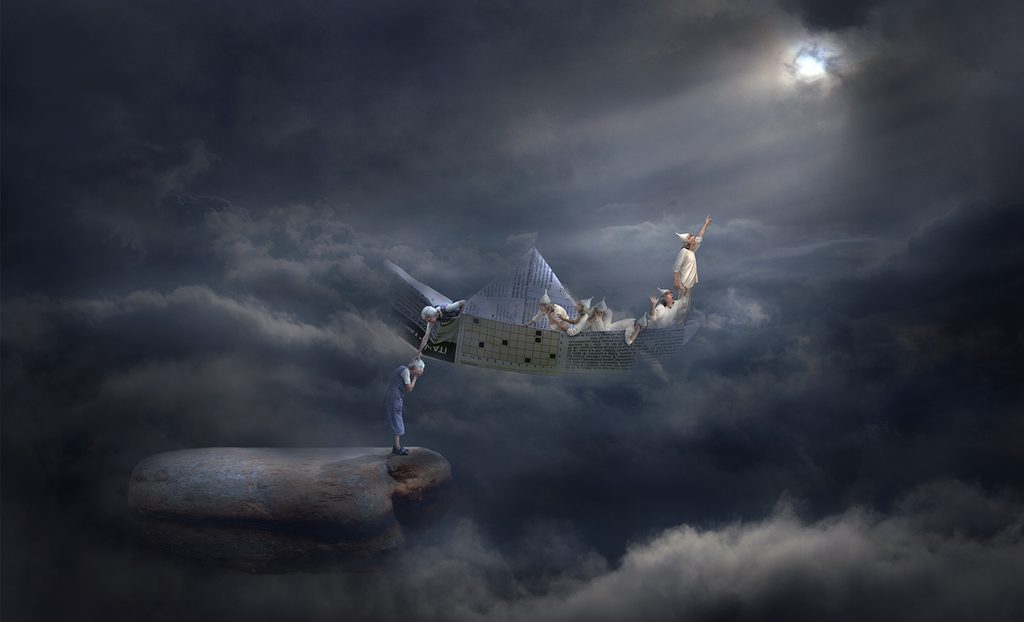
The philosopher Roland Barthes maintained that any image contains a considerable number of different messages. The need to adapt this evidence to contemporary creation is essential. In this sense, Jordi Urbón’s most recent works engage in a dialectical interplay with the image that goes beyond the conventional limits of interpretation. It is not only the symbolic resonance and emblematic nature of the elements that make up his work that invite us not to constrain its possible readings; the narrative richness of his pictures also points towards a diversification of meanings.
We encounter surreal images of figures inhabiting fictional worlds, with certain desolate undertones, charged with content and expressiveness, which lead the viewer to construct their own narrative. At first glance, these scenes might appear completely removed from reality, yet despite their fictional nature, they inhabit a territory that is by no means alien to us. The figures are projected into unsettling places, and the dreamlike elements on which they draw seem intended to stir the deepest recesses of the human being. In this way, Jordi Urbón turns art into an instrument for exploring new states of consciousness.
Through a meticulously articulated visual language, Urbón develops a language of his own based on the exploration of different techniques and the dissolution of the dominance of any single artistic tool. Although the artist’s engagement with digital media might suggest that he has abandoned painting, his connection with the pictorial does not disappear; rather, it shifts towards new working strategies. Through this approach, Jordi Urbón demonstrates that pictorial registers can transcend conventional boundaries and perhaps allow the pictorial legacy of past centuries to show through.
Thus, in the work considered here, the use of different visual processes broadens the strategies of artistic representation and encourages the transgression of the semiotic boundaries of classical genres, offering the viewer interpretative codes that extend beyond the resources employed. The artist makes use of a rigorous formal construction whose result once again evokes the language of painting, allowing technique to recede into the background so that the metaphorical density contained within each element can emerge without restrictive boundaries. Indeed, his working method is fully situated within the processes of cross-fertilisation and hybridisation associated with the digital media that permeate contemporary artistic practice.
Jordi Urbón creates a liminal space that moves within ambiguity, where the most intimate aspects of the human condition converge. His figures seem to stand at a kind of crossroads, on the threshold of the abyss, within a troubled territory that draws them towards an unknown world. They could indeed be seen as a metaphor for our times. The solitude, isolation, lack of communication and unease that permeate contemporary human existence are laid bare in an age in which the individual is condemned to inhabit a reality that casts them into helplessness, into the intangible. It is therefore through the profound interweaving of the subject’s most individual experiences and their projection into the surrounding world that the work gives expression to the fractures of the human being.