Centro Cultural La Marineta
Comisaria Marta Busquets
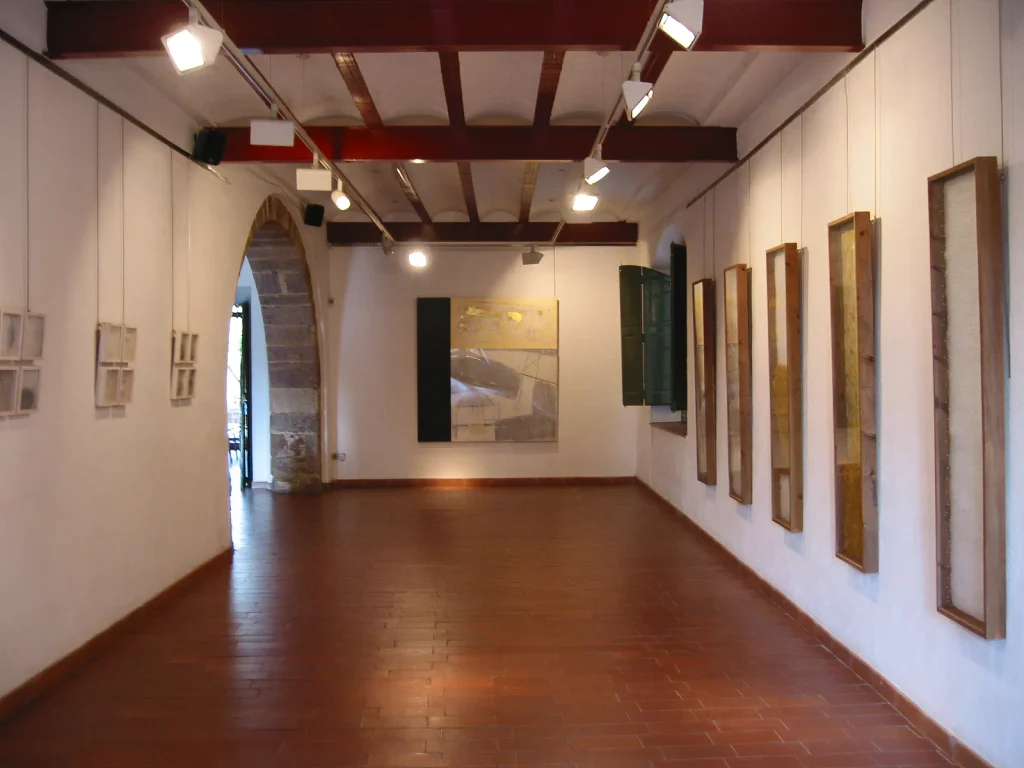


FROM INSIDE TO OUTSIDE AND FROM OUTSIDE TO INSIDE
The passage of time, the passage through spaces travelled, lived, felt and explored. The traces and marks of what we have enjoyed and suffered; the hardships and the good moments that growing up has left us; becoming greater and becoming smaller, fragments of life held within memories, emotions and learned gestures that sustain us each day; traces of what we have been, of what we are and of what we cease to be with every movement we make, with every conscious action that connects us to the most essential part of existence.
His name is Jordi Urbón, and he lives observing how the things that exist today cease to exist tomorrow. Through the windows of the trains he drives, he watches landscapes and passengers pass by, renewed each day, and around himself he has created a world populated by clues and signs of this daily passing of time. They are small boxes, reliquaries and display cases that reveal their interiors while allowing the outside world to enter as well, yet protecting them behind glass, because what lies within can easily be broken by the blows of the world. The materials speak of this inner fragility, as does the forceful line, sometimes interrupted, stretched, torn from colour as it fades or bursts forth as far as the white, the emptiness, will allow. For emptiness holds as much sway in Jordi’s works as fullness; therein lies their strength and their tenderness.
The outside, by contrast, is solid, emblematic, religious: a semicircular, double-splayed arched window in a Romanesque church; cemetery niches; the vaults of arcaded squares; the small windows that open onto the façades of houses, revealing to the street part of the life contained within. The dialogue established between these two realities, inside and outside, is not without enigmas and questions. Yet if one stops to look and allows oneself to enter into the work, one may at first feel enveloped by the aesthetic gentleness that emanates from it. But by remaining and looking more closely, one begins to recognise signs of lived experience, sediments of stories completed through the course of time, traces and marks coming from distant paths that finally meet, freeing themselves and flowing together.
Jordi lives in the Ripollès and works in a place that belongs more to the past than to the present: an old industrial colony worn down by hardship and by the modest lives and privations of workers whom the factory owner kept under close control. Close to nature and the river, the artist’s spirit expands and creates, yet the memories that permeate the space seep into his work, colouring it with a certain mystery and sprinkling it with rain, snowflakes, gusts of air and clumps of mud. The innocence of childhood, the energy of youth and the detachment of maturity meet and take leave of one another in the impermanences of Jordi Urbón.
Marta Busquets Exhibition Commissioner
